
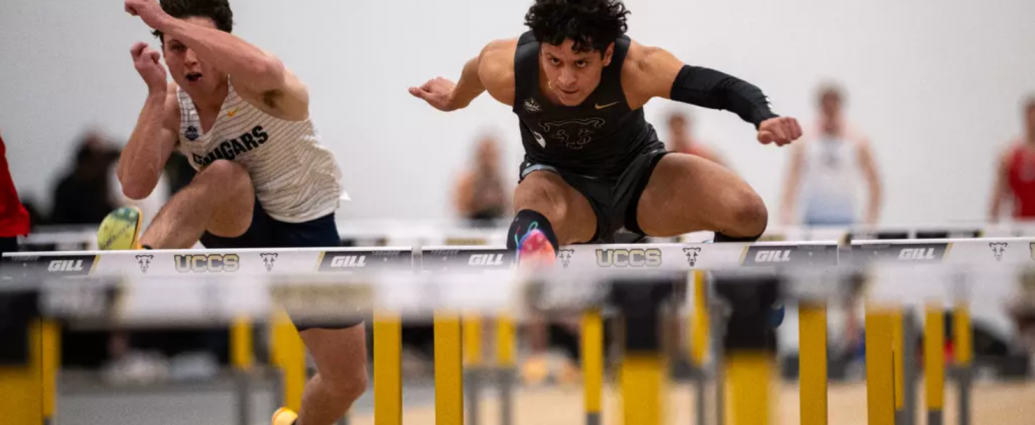
On Friday March 13, the UCCS men’s and women’s track and field teams traveled to Virginia Beach to compete in the two-day NCAA Division II Indoor Track and Field Championships.
For UCCS, there were nine different athletes who earned Second Team All-America honors between the two days.
On day one, five Mountain Lions were honored. Junior Krissie Sanders placed 15th in the preliminary round of the women’s 60m hurdles.
Seniors Michael Roberts and Savannah Jorgens had tosses of 19.91m and 18.60m to finish 12th and 10th in their respective weight throw competitions.
Junior Emma Montoya finished 16th in the prelim field with a mile time of 4:58.32, and senior Kseniya Nikanorov raced to a 15th place finish with a 5000m time of 17:14.54.
On day two, four more Mountain Lions were honored as senior Dillon Arvayo compiled 5,016 points across the two-day competition which placed him 13th in the men’s heptathlon field.
Meanwhile, the men’s 4x400m relay team of senior Sebastien Jean, redshirt junior Andrew Muncy, freshman Joshua Gross, and freshman Hayden Fox raced to an 11th place finish with a time of 3:13.32.
There were high expectations going into nationals as both teams ran away with first place in the 2026 RMAC Indoor Track and Field Championship just two weeks earlier. However, even with the personal accolades, no one placed high enough to score points for either team.
This was unexpected considering there were several RMAC teams that UCCS dominated in the conference meet who ended up scoring well at nationals like Colorado School of Mines, Adams State University and CSU Pueblo who all had top 15 finishes for both men’s and women’s teams.
How does the script flip in just two weeks? It seems unlikely that such strong performances from UCCS in the RMAC Championship would diminish against the same teams two weeks later.
This is due to the simple fact that the Mountain Lions are not competing against the same teams.
For both men’s and women’s, the three schools previously mentioned all restructured their lineup so that their best performers were well rested and performing only in competitions that counted towards a national mark, which means sitting those athletes for the RMAC Championship.
For example, the women’s team for Adams State University placed fifth in the RMAC Championship but then placed third in the DII National Championships.
This differed from their approach at the RMAC Championships where three of their best athletes only competed in one event, explaining why they placed lower than they did at nationals.
While some teams took this same approach, there were teams like the CSU Pueblo men’s team who downright rested their best runners during the RMAC Championship so that they would perform better at nationals.
At the RMAC Championship they had several inexperienced freshman and sophomores running for them whereas at nationals they had their top juniors and seniors running for them who all placed inside the top ten which helped them to a 9th place finish overall.
This was a strategy that UCCS did not employ as all of their top runners ran in both the RMAC Championship and nationals.
If you take this and combine it with the fact that track and field is a volatile sport, with first and 10th place being often separated by mere seconds, it makes sense why neither team pointed at nationals.
While this disappointing performance does mark the end of the indoor season, it does not mark the end of the track and field season as the two teams rolled immediately into the outdoor season where they have already competed in seven meets.
Pictured: Tre Garcia. Photo by Gomountainlions.