
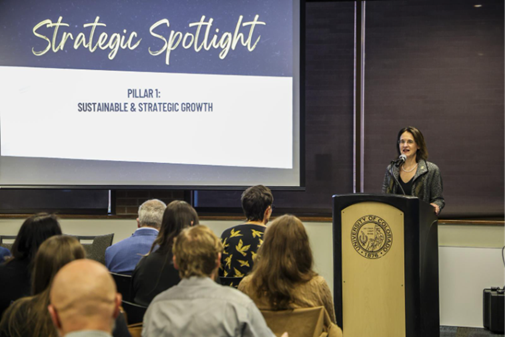
As the only research university in southern Colorado, UCCS hosted a panel of faculty members and students who highlighted research that incorporates pillar two, research and creative excellence, at the third session of the Strategic Spotlight series on Feb. 18.
The Strategic Spotlight series focuses on the four pillars of the 2030 Strategic Plan: strategic growth, research and creative works, organizational excellence and a culture of care. These pillars were designed to demonstrate how strategic planning, cross-campus collaboration and a commitment to student success can drive meaningful change.
“This pillar shines a light on our status and our commitment to discovery, creative inquiry and contributes to the broader world, [centering] the faculty, staff and students to pursue bold ideas,” Sobanet said. “Their work strengthens learning, addresses real challenges and positions UCCS as a trusted partner across southern Colorado and beyond.”
During the Q&A segment of the event, which was moderated by Hillary Fouts, the dean of the graduate school, panelists shared how they entered their fields, what drives their work and how they navigate a rapidly changing research landscape.
They also credited UCCS’ curiosity, mentorship, community resources and opportunities as drivers of their careers.
Despite these successes, panelists voiced concerns over technological acceleration like AI, rising student burnout and funding cuts in light of the projected $27 million budget cut over the next five years.
“Right now, all of our work is directly being targeted … They just eliminated NSF’s dissertation funding program. It’s really hard,” Wood said. “At the end of the day, I am still doing the work whether we have funding or not.”
According to Sobanet, UCCS will remain dedicated to continuing the university’s role as a center for innovation, creativity and community impact by supporting research initiatives that uphold the core pillars of the 2030 Strategic Plan Pillars.
“Whether through research, interdisciplinary collaboration, or the collaboration of new knowledge that improves lives, UCCS is increasingly recognized as a place where ideas are put into action. These foster our visibility, deepen trust and position us as a significant intellectual and creative research resource for Southern Colorado and beyond,” Fouts said.
Below is a descriptive list of all the panelists and their research.
Graduate student and Top Scholar Recipient Minoti Karnik
Kartnik is researching childhood development, focusing on how home, school and family environments effect metacognition, emotional awareness and moral understanding.
In December 2025, she earned the Top Scholars Award at Mountain Lion Research Day, for her project, “The Development of Metamemory Ratings and Justifications during Middle Childhood on research populations aged 8 to 13 years old,” which focused on discovering the best way to predict memory.
“Supportive faculty and lab mates create the kind of environment where I can grow without feeling like I’m falling behind,” Kartnik said, crediting supportive mentors and collaborative lab culture for fostering her academic growth.
Electrical and Computer Engineering Associate Professor Darshika Perera
Perera leads one of the largest engineering research groups at UCCS. It emphasizes cross-disciplinary exploration and is deeply committed to mentoring graduate students by guiding them through major research milestones.
Two graduate students, Mokhles Mohsin and Ahmed Alrasasi, are helping create a framework for future research in next generation, edge computing platforms.
“I am excited about all my projects, I love exploring new fields and mentoring students,” Perera said. “Seeing the spark in my students’ eyes when they talk about their accomplishments heightens my motivation to engage in research.”
Philosophy Teaching Professor Joseph Kuzma
Kuzma integrates continental philosophy, contemplative traditions and technology studies to explore how technological acceleration reshapes human purpose, presence and attention.
As a C3 faculty member, Kuzma will be developing an AI Ethics Literacy Initiative with C3 Innovation, a multidisciplinary collaboration focused on curiosity, creativity and community, with students as research assistants.
“Frankly, a lot of students are exhausted by the constant pressure to optimize themselves, the change in environment has made my work and probably all of our work more urgent, the real innovation is not building faster, smarter tools, but actually learning how to stop, how to be present, how to resist the algorithmic capture of every moment,” Kuzma said.
Assistant Professor in Anthropology Rebecca Wood
Wood’s research centers on Indigenous language reclamation, sociocultural knowledge, language ideology and community-based knowledge transmission. She also researches outdoor recreation through the lenses of inequality, gender, land use and culture.
Mentoring undergraduate and postdoctoral researchers, Wood’s work is designed to expand access to community language resources and support ethical, collaborative research practices.
“Students’ knowledge is sacred, especially when they work with culturally sensitive materials. It’s our job to teach how research translates into meaningful community impact,” Wood said.
Associate Professor of Theatre and Theaterworks Artistic Director Max Shulman
As Artistic Director, Schulman’s work centers around liveness, community and meaningful public engagement in creative and educational work, offering students hands-on experience in professional theater production.
“Liveness, community, and presence provide experiences we cannot get anywhere else,” Schulman said.
Schulman’s directing credits include UCCS productions “Marie Antoinette,” “Indecent,” “Everybody” and “Ugly Lies the Bone.”
Assistant Professor in Nursing Deborah Pina-Thomas
Pina-Thomas focuses her research on healthcare simulation that supports trauma‑informed learning, psychological safety, antiracism training and empathy development.
Through virtual reality and innovative simulation design, she works to better prepare nursing students for mental health care environments.
“Simulation boosts students’ confidence and competence, so they can deliver better patient care and reduce stigma,” Pina-Thomas said.
Students can view all projects that involve research and creative excellence here.