
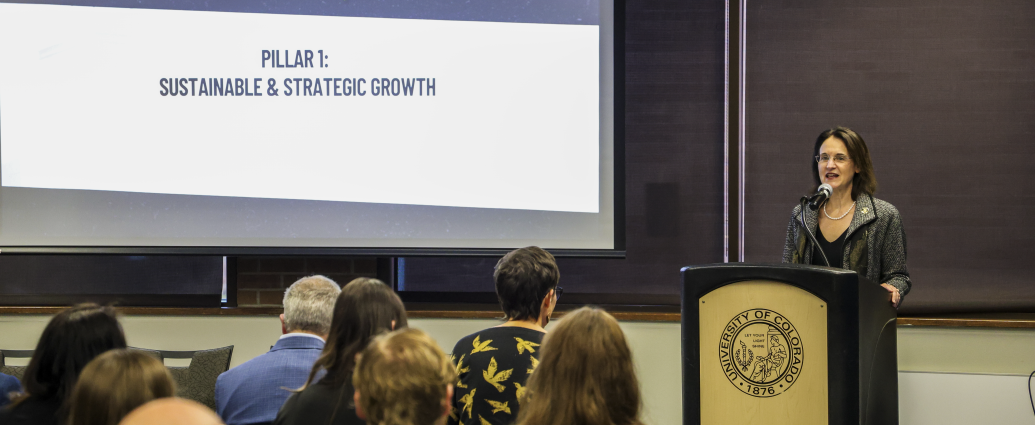
At the second session of the Strategic Spotlight series on Nov. 20, UCCS focused on funded projects, program growth and dual-enrollment opportunities to exemplify the campus’s first core pillar: sustainable and strategic growth.
The Strategic Spotlight series is designed to reaffirm priorities set in the 2030 Strategic Plan, which was introduced in Feb. 2020, by demonstrating how strategic planning, cross-campus collaboration and a commitment to student success can drive meaningful change.
“Today we shine a spotlight on … a pillar that touches everything, from enrollment and access to infrastructure and innovation. At its core, this pillar affirms our commitment to growing with intention, enhancing our student recruitment and retention efforts,” Chancellor Jennifer Sobanet said.
Green Action Fund (GAF)
GAF, a student-led sustainability organization, funds projects via a student fee that costs $6.55 per fall and spring semester and $3.38 per summer semester. According to Jenna McCallum, GAF’s grant coordinator, the 2024-2025 academic year was the organization’s largest and most successful round of funding, investing $180,000 into over 20 student-focused projects.
Projects include bulk hygiene stations to reduce plastic waste and student costs, the Mountain Metro Bus Pass Pilot — which provided 2,700 free passes for students — and the Beekeeping Program, which has over 40 student participants.
“[GAF] exists to help students create the campus they want to live and work in by funding student ideas, building student leadership and investing in projects that improve the daily life at UCCS,” McCallum said, “Every project we fund leaves a lasting footprint, not just on the environment, but on the students who lead them.”
Elevating Public Service
Associate Dean of the College of Public Service and professor Regina Winter presented how the College of Public Service promotes strategic communication and sustainable growth through data-informed decisions, community partnerships and student-centered innovation.
According to Winters, the College of Public Service has grown by 22 percent since 2019, focusing on flexibility and workforce alignment to adapt to student and community needs.
The college offers many stackable credits for graduate students, faith-based nonprofit management programs and program specializations in social work and the military. Management programs collaborate with the philosophy department to provide students with experiential learning opportunities via capstones, internships and service-learning projects with various agencies like judicial districts and hospitals.
According to Winters, the value of the students’ contributions to the Colorado Springs community during the 2024-2025 school year is an estimated $3.4 million.
Accelerating Careers in Teaching
Alternative Licensure Faculty Director and Accelerated Careers in Teaching Faculty Director, Curtis Turner presented the Addressing the Teacher Shortage with Innovation, or ACT Program.
According to Turner, the program was designed to address the teacher shortage and increase graduation rates among those studying to become a teacher by offering an affordable and accelerated option for individuals who hold a bachelor’s degree but no teaching credentials.
Students who complete the ACT program earn nine graduate-level credit hours toward a master’s in teaching at the UCCS College of Education and demonstrate skill through job-embedded training while working full-time as teachers.
The program is designed to last one year and cost a total of $7,000, which is approximately $18,000 cheaper than traditional routes, according to Turner.
This program was implemented July 2025 with 41 candidates — 16 more than expected. With rolling admissions, candidates can apply at any time.
High school access programs and admissions initiatives
UCCS is partnering with high schools to offer concurrent and dual enrollment programs that expand access, increase enrollment and support workforce development across Colorado.
Concurrent and dual enrollment programs create early engagement opportunities and reduce barriers to high education by allowing students to earn college credit while still earning their high school diploma.
According to Assistant Vice Chancellor of Enrollment Management Jevita Rodgers, over 100 high school students enrolled in the fall 2025 semester, and participation is expected to increase significantly in the upcoming semesters.
Concurrent enrollment is offered at the community college tuition rate, as required by state law. The Extended Studies and Academic Outreach Department has established an office for high school programs to streamline the enrollment process.
To increase enrollment, Clyde’s Commitment guarantees general admission for Colorado students with a minimum 2.75 GPA come their junior year of high school.
The next strategic spotlight will focus on second core pillar: research and creative works, on Feb. 19 in Berger Hall.
Chancellor Sobanet speaks at the Strategic Spotlight. Photo by Josiah Dolan.