
Not all learning happens in the classroom. Learning can take place just about anywhere: office hours, journals, discord servers, the list goes on. If you’re interested in learning beyond the classroom but don’t know where to begin, here are some starting points.
Office Hours
Office hours are the most important entry on this list. There is a widely held conception that to attend office hours you must have a formal question about something related to a course. This is not the case and bucking that assumption can open so many new opportunities for learning about a professor’s field.
Faculty are mandated to hold office hours. The purpose of office hours is to provide a way for students to talk with their professors. Of course, office hours can be about class content, but I’ve had conversations about topics ranging from graduate school to the health of family, to the most recent word I have learned.
Office hours are the single best resource for furthering learning outside of the classroom. Professors want students to come. Office hours are only partially for discussing class content.
Discord Servers
There are a wide variety of subject-focused discord servers that can be accessed with a simple web search. Being in a handful of these servers myself, they are generally friendly and accessible for all levels of study.
Usually these communities consist of undergraduates, graduate students, alumni, professors, high school students and just people who are interested in the topics. Discussion can be detailed and specialized, and at other times broad and approachable.
Servers’ populations range anywhere from hundreds to hundreds of thousands of users. They routinely host lectures and reading groups, and they almost always provide their own indices of resources.
Servers can be a helpful resource for engaging with new perspectives on a topic and talking through concepts with other scholars.
Excel Centers
More at home are UCCS’ four Excel Centers — the Languages Center, the Mathematics Center, the Multiliteracy Center and the Science Center.
In these centers, learning happens via discussion with other dedicated students and mentors.
Even if you’re shy — like I am — you can pick up a handful of good ideas and perspectives by just hanging around in these centers as study or relaxation areas. None of the centers take themselves too seriously, and they welcome a fluid sort of usage. They also have free coffee, tea and snacks.
Student Organizations and Clubs
There are several clubs and organizations dedicated to putting students in conversation around important matters, on an area of study or elsewhere.
The environment of a club meeting is not typically invested in discussing hard facts and doing hard argumentation, but it is a differently valuable environment for getting a feel for a topic and what other students in the discipline are up to.
Some clubs meet every week and others meet monthly. Spending 10 minutes scrolling through the student organizations on Mountain Lion Connect can leave you feeling informed about clubs you did not know about previously, some of which might pique your interest.
Journals
While UCCS may not have access to the wealth of academic journals that a school like Harvard has access to, we still have access to some great ones.
My favorite journals are JSTOR and Philosopher’s Index. JSTOR is wonderful because of the radical thought published and the wealth of historical articles. Philosopher’s Index is great because its submissions are peer reviewed and without corporate influence.
To access the database for the more than 300 journals, the Kraemer Family Library (KFL) page has search features, a database listing and advice for operating the tool and doing research in general. You can talk to KFL librarian for advice on the latter too. Professors are also very knowledgeable about doing research.
Library Services
The library has countless other resources available. On top of checking out books, study rooms can be reserved, materials can be borrowed and periodicals can be checked out.
Furthermore, our library is part of Prospector. Books and media can be checked out from other libraries in the Prospector system across the U.S.
If Prospector still doesn’t have the materials you’re looking for, an Interlibrary Loan can be requested to get access to materials on the library’s dime.
Student Research
Student research is an incredibly beneficial way to come to know the ins and outs of academia and the contours of your area of study. The Center for Student Research (CSR) pairs faculty and students together to do just that.
CSR additionally provides students with guidance and funding for research projects and conference travel. More can be learned about CSR by clicking here.
Study Abroad and National Student Exchange
Both Study Abroad and National Student Exchange (NSE) are more direct and impactful, but costly, ways to further the pursuit of learning. Through these programs, you can study elsewhere nationally or internationally during the school semester.
National student exchange sends students abroad domestically and is relatively affordable. Study Abroad is less affordable, although money from financial aid and some scholarships apply. For more information on Study Abroad, click here. For more information on National Student Exchange, click here.
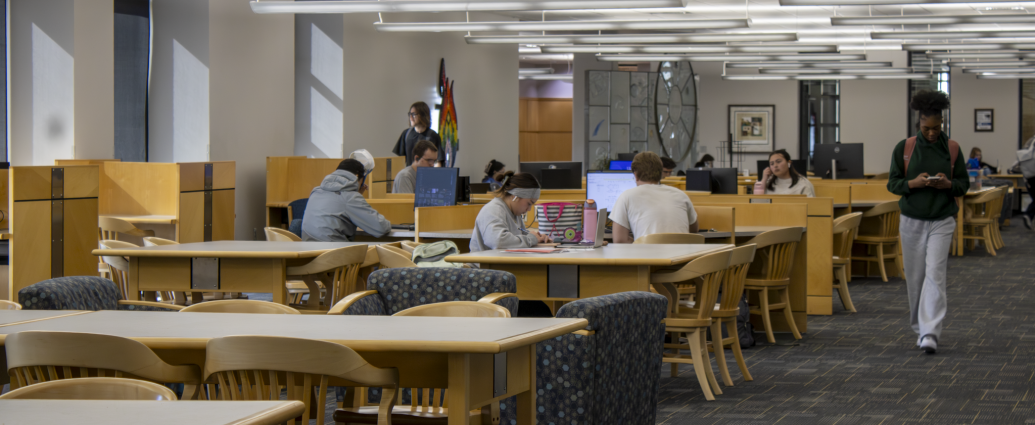
Students study inside the library. Photo by Jade Esquibel.