
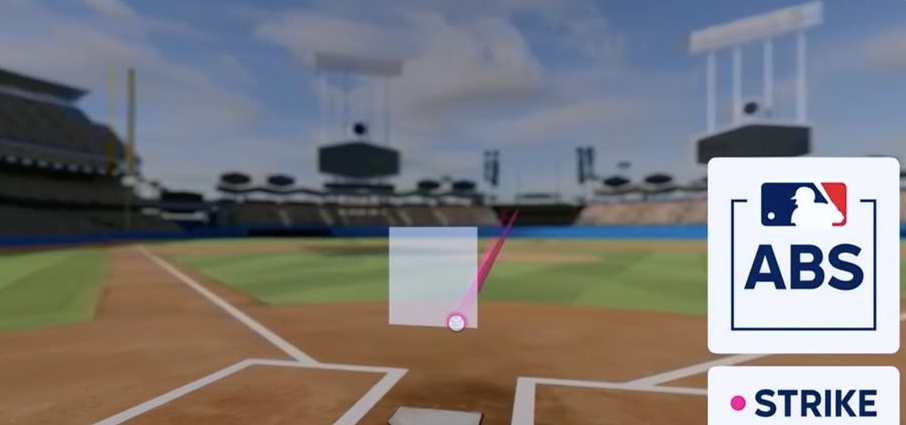
The Automatic Ball Strike (ABS) challenge system has dawned on Major League Baseball and its impact through the first month of the season cannot be understated.
The issue of blown calls behind the plate has been one of baseball’s biggest talking points over the past several decades, as many fans and players have found themselves growing frustrated with umpire inaccuracy.
ABS was created in 2021, originally designed as a “robot umpire” that would be used to replace human inconsistencies by making calls based on a fixed strike zone. The innovation drew discourse among fans.
Some felt it was time to take advantage of modern technology, while others despised the idea of taking the human element out of the game.
Regardless, ABS was first implemented in the Arizona Fall League. Umpires used earpieces to receive ball-strike calls and would relay the call through typical hand signals.
Since then, ABS has evolved into the challenge system that we see today, with both teams receiving two challenges that they can use at their discretion.
As mentioned before, its impact through the first month of the season has been undeniable, but has that impact been positive or negative?
First impressions: ABS is good for baseball
Boy, do I wish that ABS existed while I was still playing.
Through the first month of the season, my impressions of the ABS challenge system have been largely positive. – it’s holding umpires accountable – which is the heart of why I’ve loved ABS so far.
ABS serves the same purpose as video replay, but faced far more pushback than replay ever did when it was expanded in 2014.
Both follow the same basic process. An umpire misses a call, a player or manager challenges it, and the call is corrected. Still, many fans have been hesitant to embrace this new technology, even though it accomplishes exactly what video replay does.
People often complain about pitches that catch just a sliver of the zone being called strikes, but enforcing anything beyond that would be incredibly complicated.
The best comparison I’ve heard is that it’s very similar to foul balls. If a ball lands and clips even a tiny bit of chalk, it’s still fair. In the same way, even if most of the pitch is off the plate, that small portion crossing the zone makes it a strike. See the similarity?
Doing anything other than this would only complicate the process, slowing down challenges and making ABS far messier than it needs to be.
Baseball is actively getting more calls correct, and that’s a good thing.
ABS is awesome… just don’t let it go further than this
Where I get hesitant about ABS is when conversations start going further than the current challenge system.
Jomboy Media, a major voice in baseball’s social media space, floated the idea of giving each team one ABS challenge per inning. Personally, I think this would hurt the game more than it would help it.
While yes, theoretically more calls would be corrected, teams would start spam tapping their helmets for any minor miss and the pace of the game (that MLB has been trying so hard to speed up) would suddenly slow down.
Beyond that, the change would strip away the strategic element that has made the system so compelling so far.
Because ABS is still new, teams are actively experimenting with when to use their challenges. Do you let a borderline miss go early so you can save your challenge for a high-leverage moment later, or do you use it immediately to gain any possible edge?
That decision-making process adds a subtle but fascinating layer to the game, and one that would disappear if challenges reset every inning.
I am also not on board with it fully replacing human umpires.
I am going to sound like an old head with this next bit, but slight misses are a part of the game.
We put imperfect humans behind the plate, then get frustrated when they aren’t 100% accurate. The reality is, they never will be.
The moment you stand in against a 95+ MPH fastball is the moment you realize just how difficult umpiring really is.
The goal of ABS shouldn’t be to eliminate every minor mistake, it should be to wipe out the obvious, game-altering misses when they inevitably happen.
The MLB has nailed their first attempt at correcting umpires behind the dish and I would hate to see it go further than this.
Implementation into college
Even though there have not been talks about ABS being implemented into college baseball, I would be shocked if it did not trickle down into amateur baseball over the next five years.
Just look at all the other major rule changes MLB has made recently. The pitch clock is now a part of every level of college baseball.
PitchCom has made its way all the way down to high school, and the runner on second base to start extra innings is now being implemented in youth baseball leagues across the country.
As for whether ABS should come to college baseball, I don’t see a strong argument against it. However, unlike those other rule changes, ABS presents a much bigger logistical challenge.
Implementing it requires advanced tracking technology, consistent calibration, and financial investments that aren’t as accessible for smaller programs or lower levels of college baseball.
I wouldn’t be surprised to see it in high-level DIin just a couple years, but its complexity makes it a lot harder to enforce in lower levels of the college game.
The Automated Ball Strike System. Graphic courtesy of Facebook.