
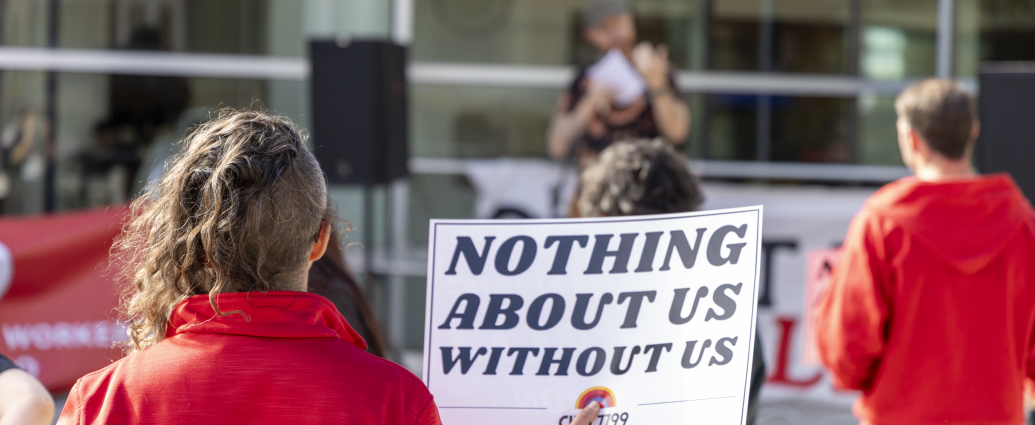
On Nov. 6, a group of staff, faculty and students protested outside University Center to campaign for collective bargaining rights for university employees before the Board of Regents meeting in Berger Hall.
The event was organized and hosted by the Communications Workers Association (CWA) 7799 and the United Campus Workers of Colorado (UCWC). UCWC is the largest higher education union in Colorado, representing over 50,000 university employees across the CU system, according to their website.
Collective bargaining rights are the ability of a union to negotiate wages, working hours, benefits and other workplace issues, according to the U.S. Department of Labor.
The event was emceed by Dylan Harris, president of the UCCS chapter of the American Association of University Professors (AAUP), UCWC faculty representative and assistant professor in the Department of Geography and Environmental Studies. Union members and UCCS faculty spoke about their concerns and called for solutions to affordability issues for campus workers, fair wages and increased academic freedom.
Affordability concerns
According to Jess Ellis, staff researcher at CU Anschutz and president of the UCWC, collective bargaining is meant to address wages, stipends, and the rising cost of living and it impacts university staff and faculty.
“We are getting charged for the privilege of coming to work. We are getting charged in the parking lots, we are getting charged on our commutes because most of us can’t live close to our universities anymore. We have to live farther and farther away because the cost of living is too high,” Ellis said.
Collective bargaining rights would give university workers the ability to advocate for fairer working conditions and secure better access to healthcare, according to Ellis.
“When you have a strong union, strong collective bargaining rights, you write the deal. We enforce the deal together, and we can make our own lives better,” Ellis said, “We need the right to bargain, and I know that this union can win the right to bargain.”
According to the UCWC website, CWA 7799 won collective bargaining rights for 15,000 city and municipal workers in Denver last year.
Evan Taparata, assistant professor in the history department, addressed mismatched faculty salaries and costs of living in Colorado.
Taparata discussed a SmartAsset report that ranked Colorado with the ninth highest annual salary needed for a single adult to live comfortably at $105,955. The average salary for a UCCS faculty member is $80,098.53, according to previous Scribe reporting.
“I don’t make enough money on this salary to make ends meet, and every year since I started my job here, I’ve accrued more debt than the year before,” Taparata said.
According to Taparata, the high expectations placed on new faculty members can often delay their research and writing until the summer. UCCS faculty members operate on nine-month contracts. “The work we do in the summer is by default unpaid labor,” he said.
According to Taparata, even when faculty members receive wage increases, they are usually outpaced by growing inflation.
“The message to us, the workers of this university, has been the same over and again: to do more with less and be grateful for it,” Taparata said. Taparata added that he is thankful for the work he gets to do, but that “gratitude don’t pay the bills.”
Student and faculty wages
Securing collective bargaining rights would allow university members to negotiate their wages and receive annual raises, according to the UCWC website.
“This year, no one is getting a raise here, because we didn’t meet an impossible enrollment threshold that we didn’t agree to,” Harris said.
According to Harris, UCCS administrators imposed a 1.5 percent enrollment threshold on faculty members for the 25-26 academic year to combat falling enrollment rates. In order for faculty members to receive a raise, enrollment had to increase by at least 1.5 percent; however, UCCS enrollment decreased, according to CU Connections.
Following the closures of three Big Cat Coffee locations on campus, Harris said student employees are also under increasing pressure. “Our student workers are being screwed, over and over again. They don’t have any representation. Half of our jobs closed this semester, and they don’t have work,” he said.
“Collective bargaining is a stable and legal way to hold standards and accountability. The leadership should not set the standards for how our policies are interpreted, how accountability for student employees is interpreted, and most importantly, how student employees are being advocated for,” said Isabella Polombo, vice president of SGA.
Academic freedom
According to the AAUP, academic freedom refers to the ability of an instructor to teach course subjects without administrators, boards of trustees, political figures, donors or other entities interfering. Academic freedom includes the right of faculty members to select their course materials and free speech protections.
Harris highlighted the importance of academic freedom, mentioning that without it, UCCS is doing a “worse job for our students, for our colleagues, for the state of Colorado.” Harris called for academic freedom to be protected in the UCWC’s collective bargaining agreement.
“Under this Trump administration, what we research is being scrutinized, what grants we pursue are being defunded and identities like my own are being erased,” CWA 7799 President Jade Kelly said.
Recent executive orders by the Trump administration limit the use of certain words in research and grant proposals, in line with anti-DEI efforts. “Banning words like ‘women’ in our grants, banning words like ‘diversity,’ banning words like ‘equity,’ that’s not freedom. That’s fear disguised as pragmatism to try and pretend everything is alright,” Kelly said.
Kelly called these measures an assault on worker freedom that began before the Trump administration. “It started the day our campus decided that profit matters more than people,” Kelly said. “That’s not just a policy, that’s power unchecked.”
According to Kelly, collective bargaining rights are necessary to secure academic freedom for university faculty. “None of us are free when academic freedom and worker freedom are seen as erasable, debatable and ultimately sacrificed in boardrooms without us.”
Employee retention
According to UCWC’s website, one in four public sector workers in Colorado will leave their jobs this year, making Colorado’s turnover rate among the worst in the country.
“That is not just turnover, that is a cry for help. That’s an institutional problem, that is willing to lose talent, lose knowledge, lose human beings who have given their lives to helping students learn,” Kelly said.
Colorado is the only Democratic-led state in the country that does not allow university employees access to collective bargaining rights, according to the UCWC website.
“A unionized workplace is a safe workplace. It’s an equitable workplace. When teachers are well paid and rested, you see better retention. You see a higher ability to recruit faculty members,” Kelly said, “This is overdue.”
UCWC and CWA 7799 are looking for 2,000 signed collective bargaining cards from university employees. According to Kelly, if UCWC and CWA 7799 can garner enough support, The Board of Regents will vote on collective bargaining rights early next year.
University employees can contact a UCWC organizer here to sign a card.
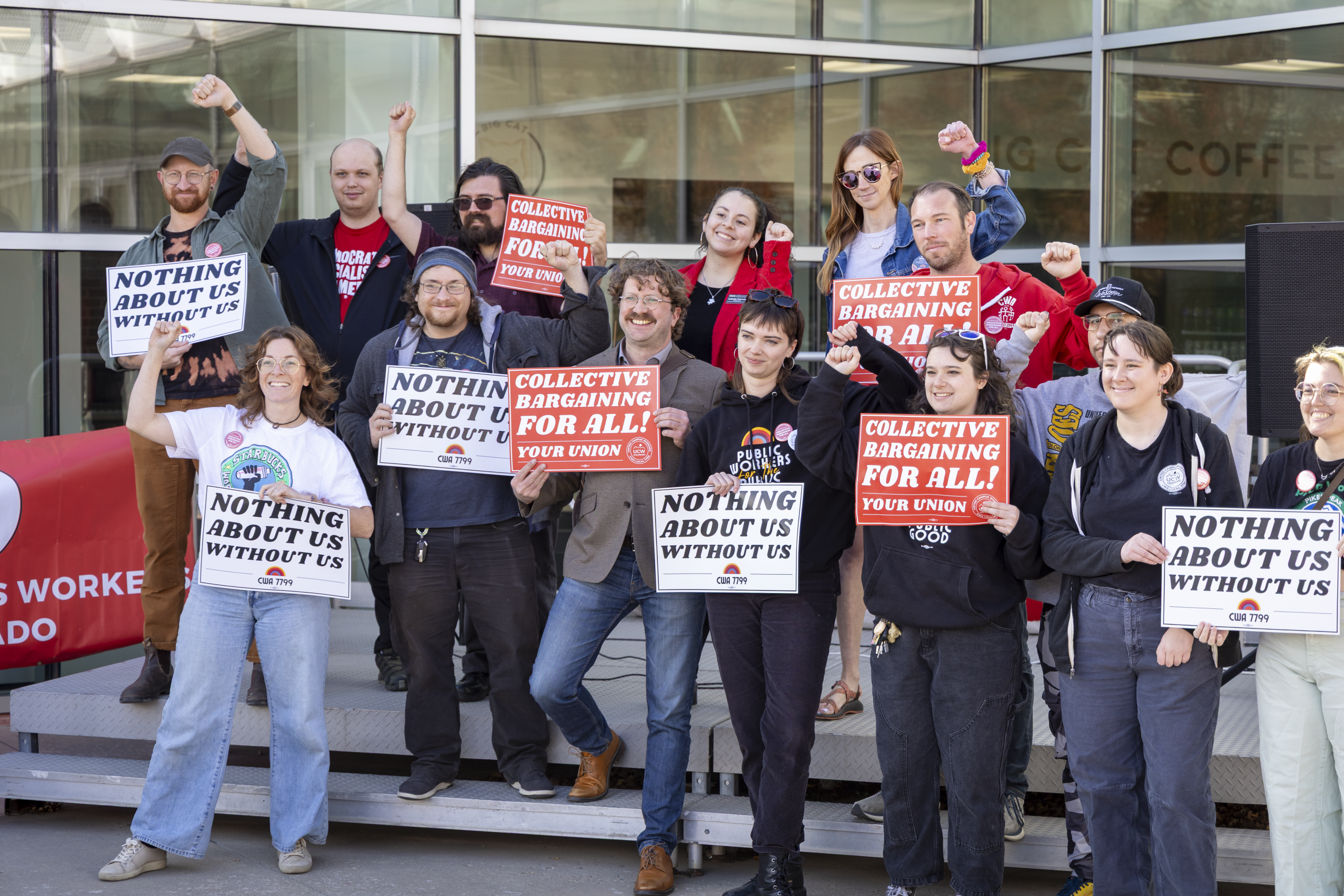
Students and faculty gather in protest outside the University Center. Photo by Josiah Dolan.